Emergency water removal, room by room
Emergency water removal in Woodland Hills means pulling standing water out before it soaks into drywall, cabinets and baseboards. The EPA’s guidance is to dry wet materials within 24 to 48 hours[EPA].
On a concrete slab, water does not drain away; it spreads sideways under baseboards and into the next room. The crew works outward from the wettest area and checks walls with moisture meters, not by touch.
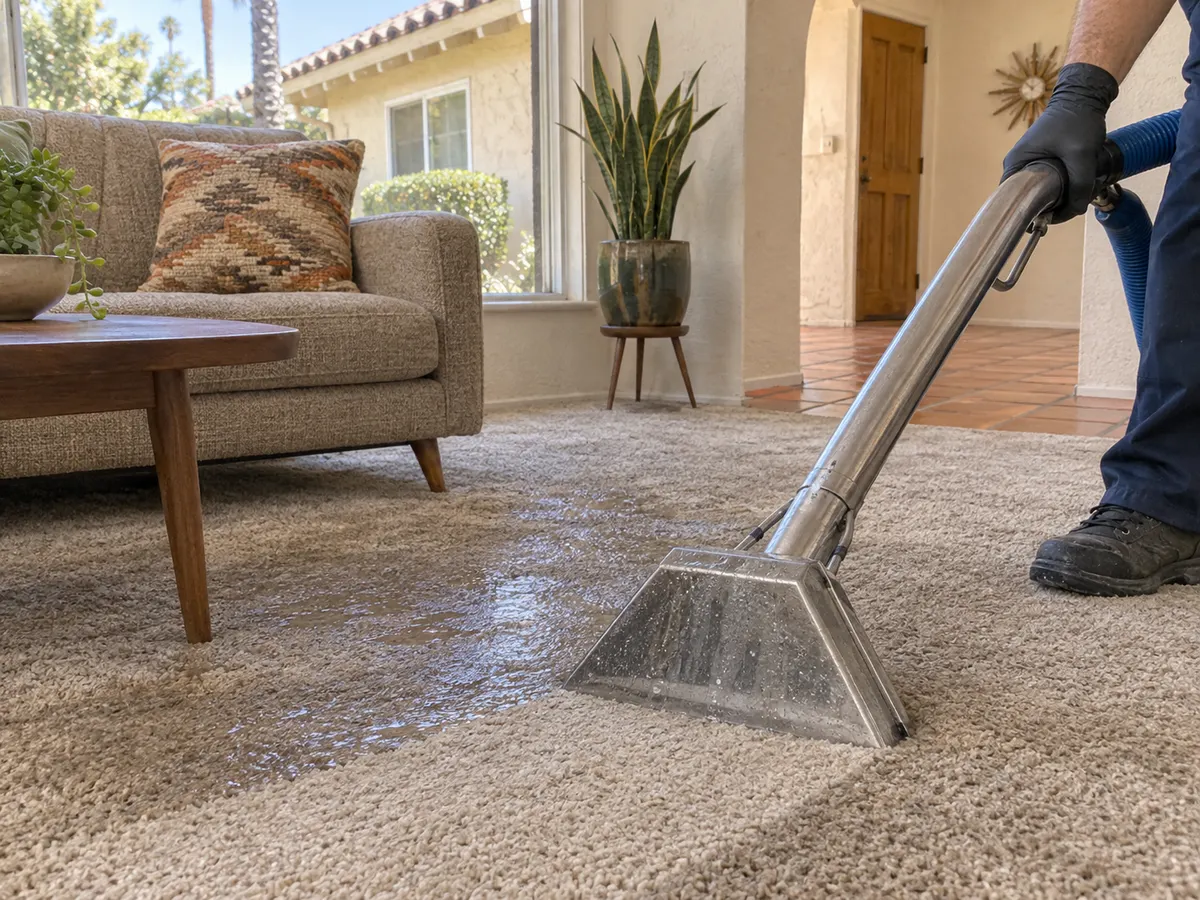
How the job usually runs
- Stop the water. Close the main shut-off or the valve at the fixture.
- Make it safe. Turn off power to wet rooms only if you can reach the panel without standing in water[CDC].
- Pump and extract. Pumps for deep water, extraction wands for carpet and pad, squeegees for tile.
- Set drying. Air movers and dehumidifiers go in once standing water is gone.
Do
- Photograph each room before anything is moved[FEMA].
- Lift furniture onto blocks or foil to protect legs and carpet.
Avoid
- Using a household vacuum on standing water.
- Walking through water near outlets or extension cords[CDC].
How water damage restoration differs by room in Woodland Hills homes
- Kitchens. Dishwasher, sink and ice maker leaks run under the cabinets. Toe kicks often come off so air can reach the floor underneath, and cabinet backs are checked with a meter.
- Bathrooms. Toilet overflows, tub drains and shower valves wet the subfloor and the wall behind the fixture. A toilet overflow from the bowl is treated by its source, and a backup through the drain is Category 3[IICRC 2026 position statement].
- Laundry rooms. Burst washer hoses release a lot of water fast, and it usually reaches the next room under the wall. Drain backups bring gray water.
- Garages and water heater closets. A leaking tank spreads across the garage slab and under the wall into the house. Stored boxes on the floor soak up water and should be moved first.
- Bedrooms and living areas. Carpet and pad hold a lot of water. Extraction comes first, then the pad is checked; soaked pad is usually replaced rather than dried.
- Ceilings. Roof leaks and AC overflows wet insulation and drywall above. Wet ceilings can sag, so the area under them is kept clear.
What water damage restoration in Woodland Hills includes
A water damage restoration job in Woodland Hills follows a set order. Each stage depends on the one before it, so the work is planned before the equipment comes off the truck.
- Inspection and moisture mapping. Moisture meters and thermal cameras trace water under flooring, inside walls and in ceilings, and the crew confirms the source is stopped.
- Water removal. Submersible pumps take out deep water, and extraction units pull water from carpet, pad and hard floors. Mechanical extraction removes water much faster than air drying can.
- Removal of what cannot dry. Soaked pad, baseboards, the lower part of wet drywall and wet insulation come out when they cannot be dried in place. The EPA says wet materials that cannot be thoroughly cleaned and dried within 24 to 48 hours should be discarded[EPA flood cleanup guide].
- Structural drying. Dehumidifiers and air movers run in a closed space, and the goal is relative humidity under 60 percent, ideally 30 to 50 percent[EPA].
- Cleaning. Surfaces touched by contaminated water are cleaned and disinfected. The CDC says to throw away items that cannot be disinfected, such as wall coverings, cloth, rugs and drywall[CDC].
- Final readings. Equipment stays until moisture readings in the walls, subfloor and framing return to normal, and those readings are written down.
How restoration crews in Woodland Hills classify water
Restoration companies sort water by how contaminated it is, using the IICRC categories. Category 3 is grossly contaminated: sewage, waste line backflows from beyond a trap, seawater, rising rivers or streams, and contaminated wind-driven rain[IICRC 2026 position statement].
The category decides the order of work. Category 1 drying can start right away, while Category 2 and 3 losses get cleaned up under contamination controls before drying begins[IICRC 2026 position statement]. Storm water is not automatically Category 3; the restorer decides after inspecting[IICRC 2026 position statement].
A clean leak does not stay clean forever. Time and temperature can change the category[IICRC 2026 position statement], and a warm house speeds that up.
Where water hides in Woodland Hills homes
On a concrete slab, water does not drain away. It spreads sideways under baseboards, cabinets and flooring into the next room, which is why the wet area on the meter is often larger than the wet area you can see.
The AC system is easy to overlook. A clogged condensate line backs up the drain pan, and the EPA says pans that do not drain can let water into the HVAC system[EPA]. Keep the pan clean and the line flowing[EPA].
Places to check:
- Inside walls around leaking or sweating pipes[EPA]
- Under vinyl plank, laminate and carpet pad
- Behind the refrigerator ice maker line and dishwasher
- Under the water heater and washing machine
- Roof materials above ceilings after a roof leak[EPA]
Watch for a damp smell, baseboards that swell, stains that grow, floors that cup or buckle, and a water bill higher than normal. LADWP also suggests a dye test in the toilet tank to catch silent leaks[LADWP].
Water removal and drying equipment used in Woodland Hills
- Pumps and extractors. Submersible pumps remove deep water. Extraction wands and weighted tools pull water out of carpet and pad.
- Air movers. Fans set at angles along walls and floors move air across wet materials.
- Dehumidifiers. Remove water from the air. Without them, air movers just push damp air around the room.
- Moisture meters. Measure the water in drywall, framing and subfloor, and confirm when each area is dry.
- Infrared cameras. Help locate wet areas behind finished surfaces, with meters used to confirm.
- Containment. Plastic sheeting closes off the work area, which keeps contaminated water and drying air where they belong.
After the shaking: water lines and water heaters
The magnitude 6.7 Northridge earthquake struck at 4:30 in the morning on January 17, 1994, on a buried thrust fault rooted under the San Fernando Valley[USGS]. It left more than 7,000 people injured and 20,000 residents homeless, with property damage estimated at about 40 billion dollars[USGS].
Shaking strong enough to topple water heaters and break water mains is one of the effects the USGS lists[USGS]. State law requires every residential water heater to be braced, anchored or strapped[California Health and Safety Code 19211], and the state’s bracing guidelines recommend flexible water and gas connectors along with at least two straps[California DSA].
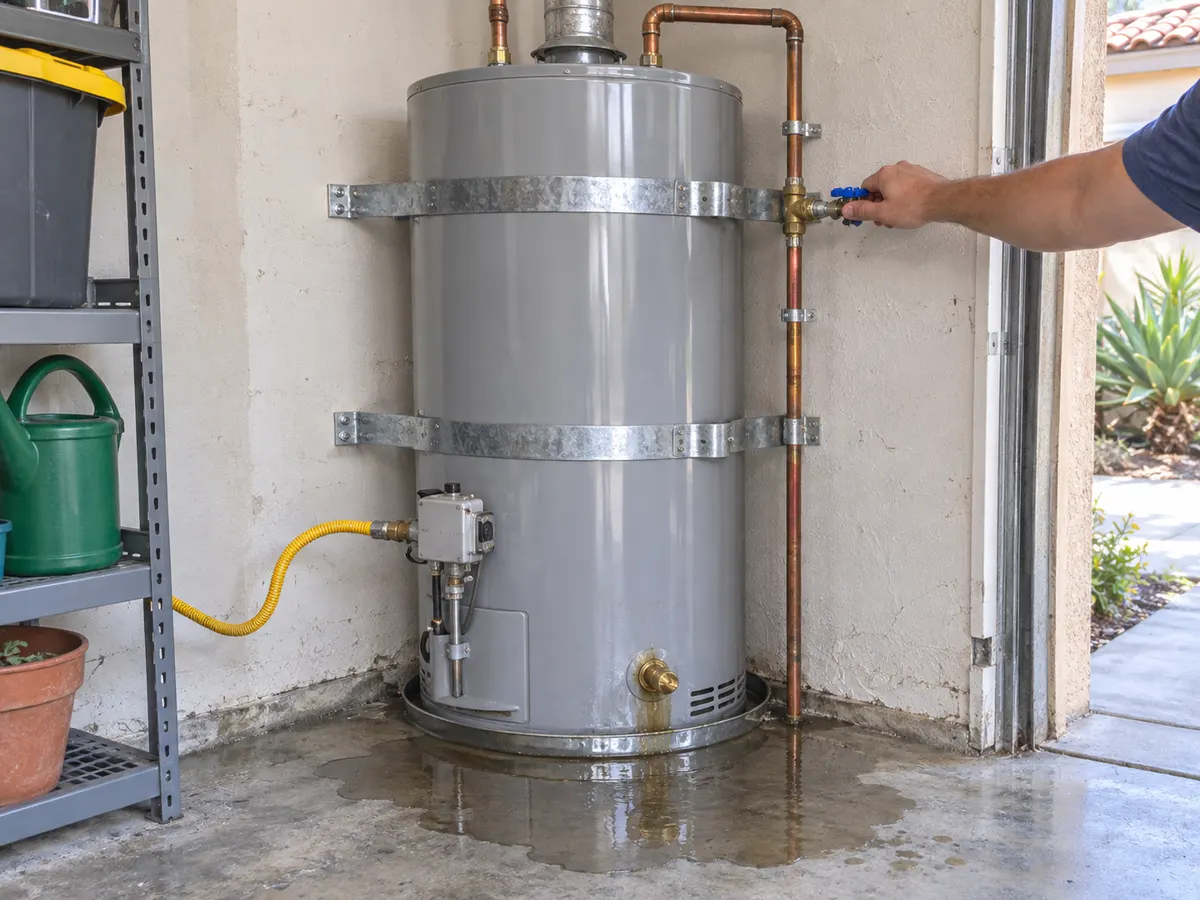
After an earthquake, check the water heater, the lines under sinks and the main shut-off before anything else. If water is running, close the main and keep out of rooms where water has reached outlets[CDC].
Questions to ask the restoration company
- Which IICRC category does this water fall into?
- Can you show me the moisture readings and the wet area on a sketch?
- Which materials are coming out, and which can be dried in place?
- When will you take readings, and when do you expect the job to be dry?
- Do I need a plumber to stop the source first?
- Will you put the scope of work in writing before you start?
A good restoration company will answer these without hesitating and will take readings before giving a plan.
Emergency water removal and Woodland Hills homes
The Census Bureau counts 31,816 housing units in ZIP codes 91364 and 91367. 52% are detached single-family houses, 43% are in buildings with two or more units, and 54% of occupied homes are owner-occupied[U.S. Census Bureau]. 63% of homes in ZIP codes 91364 and 91367 were built before 1980 and the median year built is 1967 in 91364 and 1975 in 91367[U.S. Census Bureau]. At that age, original galvanized or copper supply lines, cast-iron drains and older shut-off valves deserve a look.
Water service in Woodland Hills is LADWP’s. If water is coming up at the meter, the curb or the street, call 1-800-DIAL-DWP (1-800-342-5397); LADWP lists that line for water trouble at any hour[LADWP].
Other services in Woodland Hills
- Water damage restoration in Woodland Hills
- Water extraction
- Water mitigation
- Water damage cleanup
- Flood restoration
- Flood cleanup
- Sewage cleanup
- Burst pipe water damage