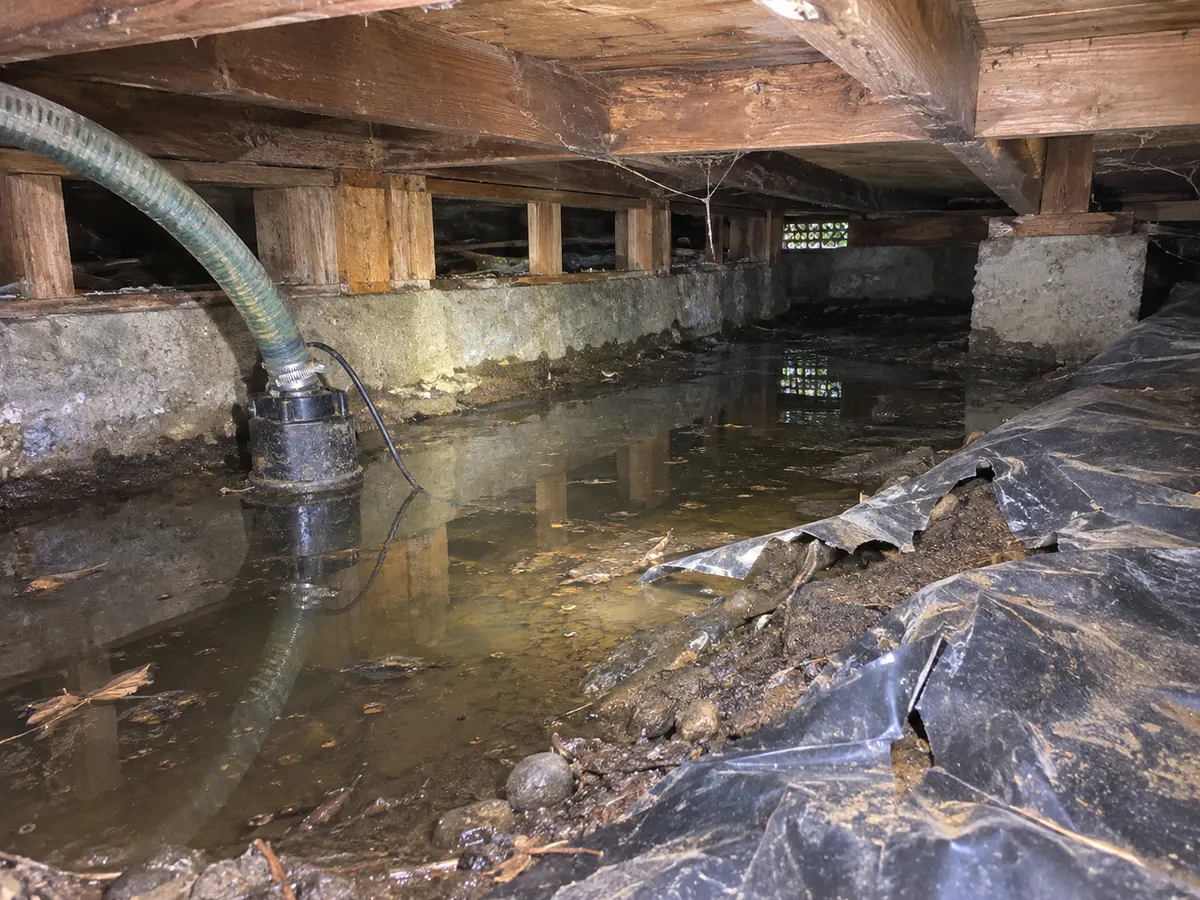
Water under a raised-floor Valley Village house
Postwar tract houses in Los Angeles often have concrete slab floors rather than raised floors with wood joists[LA City Planning], but older homes are a different story. In ZIP code 91607, 19% of homes were built before 1950[U.S. Census Bureau], and many houses from that era sit on raised foundations with a crawl space underneath.
Water from a leaking supply line, a drain or heavy rain can pool in the crawl space and stay out of sight until floors soften or a damp smell comes up through the house. The state’s Earthquake Brace + Bolt program, which helps owners retrofit raised-foundation homes, picks ZIP codes partly by their share of pre-1940 houses[Earthquake Brace + Bolt].
The crew pumps out standing water, pulls down soaked insulation, replaces damaged vapor barrier and runs drying equipment until the joists and subfloor test dry. Wet materials should be dried within 24 to 48 hours[EPA].
How the job usually runs
- Find the source. Plumbing leak, drain line or surface water.
- Pump out. Submersible pump clears standing water.
- Remove wet materials. Insulation and vapor barrier that will not dry.
- Dry under the house. Dehumidifiers until readings show dry.
Do
- Turn off water if a plumbing leak is the source.
- Keep the crawl space access closed between visits.
Avoid
- Crawling into standing water near wiring[CDC].
- Leaving wet insulation hanging on the joists.
How water damage restoration differs by room in Valley Village homes
- Kitchen. Under-sink and dishwasher leaks hide under cabinets and flooring. Crews remove toe kicks to dry beneath them.
- Bath. Water from toilets, tubs and showers gets into the subfloor and wall bottoms. Drain backups count as Category 3 water[IICRC 2026 position statement].
- Laundry. A split washer hose can put water into several rooms. Washer discharge is contaminated water, not clean water[IICRC 2026 position statement].
- Garage. Water heater leaks spread on the slab and under the wall into finished rooms.
- Carpeted rooms. Carpet is extracted, and soaked pad is usually pulled and replaced.
- Ceilings and attics. Roof and AC drain pan leaks soak insulation and drywall. Keep people and furniture out from under a sagging spot.
First steps before the crew arrives
- Stop the water. Close the fixture valve under the sink or toilet, or the main shut-off if you cannot find the source. It helps to find the main shut-off before you ever need it.
- Make it safe. Keep away from outlets, cords and fixtures that water has reached, and turn off power at the breaker only if you can do it from a dry spot[CDC].
- Document it. Take photos and video of each room, the source and damaged belongings before anything is moved[FEMA].
- Move what you can. Lift furniture onto blocks or foil, pull rugs off wet carpet, and get photos, papers and electronics to a dry room.
- Call for restoration. Drying should start within 24 to 48 hours[EPA], and extraction works better before water soaks deeper into the pad and walls.
Do not use a household vacuum on standing water, and do not turn on ceiling fans or lights under a wet ceiling.
What water damage restoration in Valley Village includes
Water damage restoration is more than pulling up wet carpet. A typical job in Valley Village moves through six stages, and skipping one is how hidden moisture gets left behind.
- Inspection and moisture mapping. Moisture meters and thermal cameras trace water under flooring, inside walls and in ceilings, and the crew confirms the source is stopped.
- Water removal. Submersible pumps take out deep water, and extraction units pull water from carpet, pad and hard floors. Mechanical extraction removes water much faster than air drying can.
- Removal of what cannot dry. Materials that will not dry in time are cut out. EPA guidance is that wet materials which cannot be thoroughly cleaned and dried within 24 to 48 hours should be thrown away[EPA flood cleanup guide].
- Structural drying. Air movers push air across wet surfaces while dehumidifiers pull the moisture out of the air. The EPA target is indoor humidity below 60 percent[EPA].
- Cleaning. Surfaces touched by contaminated water are cleaned and disinfected. The CDC says to throw away items that cannot be disinfected, such as wall coverings, cloth, rugs and drywall[CDC].
- Final readings. Equipment stays until moisture readings in the walls, subfloor and framing return to normal, and those readings are written down.
Hidden water: the spots crews check first
On a concrete slab, water does not drain away. It spreads sideways under baseboards, cabinets and flooring into the next room, which is why the wet area on the meter is often larger than the wet area you can see.
The AC system is easy to overlook. A clogged condensate line backs up the drain pan, and the EPA says pans that do not drain can let water into the HVAC system[EPA]. Keep the pan clean and the line flowing[EPA].
Places to check:
- Inside walls around leaking or sweating pipes[EPA]
- Under vinyl plank, laminate and carpet pad
- Behind the refrigerator ice maker line and dishwasher
- Under the water heater and washing machine
- Roof materials above ceilings after a roof leak[EPA]
Watch for a damp smell, baseboards that swell, stains that grow, floors that cup or buckle, and a water bill higher than normal. LADWP also suggests a dye test in the toilet tank to catch silent leaks[LADWP].
Structural drying in a dry climate
The EPA’s target is to dry wet materials within 24 to 48 hours[EPA]. A small clean-water leak caught early can often be dried in a few days. After a flood, the EPA warns that drying out can take several weeks[EPA flood cleanup guide].
Dry outdoor air is not the same as a dry wall. EPA guidance is to ventilate when outside air is cold and dry and to dehumidify when it is warm and humid[EPA], and the inside of a wet wall cavity or carpet pad still needs moving air and dehumidification to dry in time.
Leave the equipment running, keep doors to the drying area closed, and let the technician move it. Turning off air movers at night to cut noise can add days to the job.
Winter storms and roof leaks
Rain here tends to arrive in bursts. The National Weather Service’s February 2024 climate report for downtown Los Angeles shows 4.10 inches on February 4, 2.93 inches on February 5 and 12.66 inches for the month[NWS Los Angeles].
Storms like that find every weak spot: roof flashing, skylights, sliding door tracks and low garage slabs. Water that comes through the roof soaks insulation and drywall in the ceiling before it shows as a stain.
Do not stand under a sagging ceiling, and turn off power to rooms where water is near outlets or fixtures if you can do so safely[CDC].
Flood safety first
Do not walk or drive through floodwater. The National Weather Service says 6 inches of fast-moving water can knock over an adult and 12 inches of rushing water can carry away most cars[NWS].
With water in the house, turn off power at the breaker if you can do it safely, and disconnect appliances before power is restored[CDC]. Document the damage with photos before anything is moved[FEMA].
Crawl space water removal and Valley Village homes
The Census Bureau counts 14,831 housing units in ZIP code 91607. 28% are detached single-family houses, 67% are in buildings with two or more units, and 30% of occupied homes are owner-occupied[U.S. Census Bureau]. 72% of homes in ZIP code 91607 were built before 1980 and the median year built is 1969[U.S. Census Bureau]. At that age, original galvanized or copper supply lines, cast-iron drains and older shut-off valves deserve a look.
Valley Village is part of the City of Los Angeles, so water comes from LADWP. Leaks at the street, the meter or a broken main are reported to LADWP at 1-800-DIAL-DWP (1-800-342-5397), where representatives answer outage and water trouble calls around the clock[LADWP].