Water damage cleanup in the San Fernando Valley covers everything between the water stopping and the house being dry: extraction, removing soaked materials, cleaning surfaces the water touched and drying the structure.
Take photos and video before cleanup starts[FEMA], then get it moving. FEMA’s advice is not to wait[FEMA].
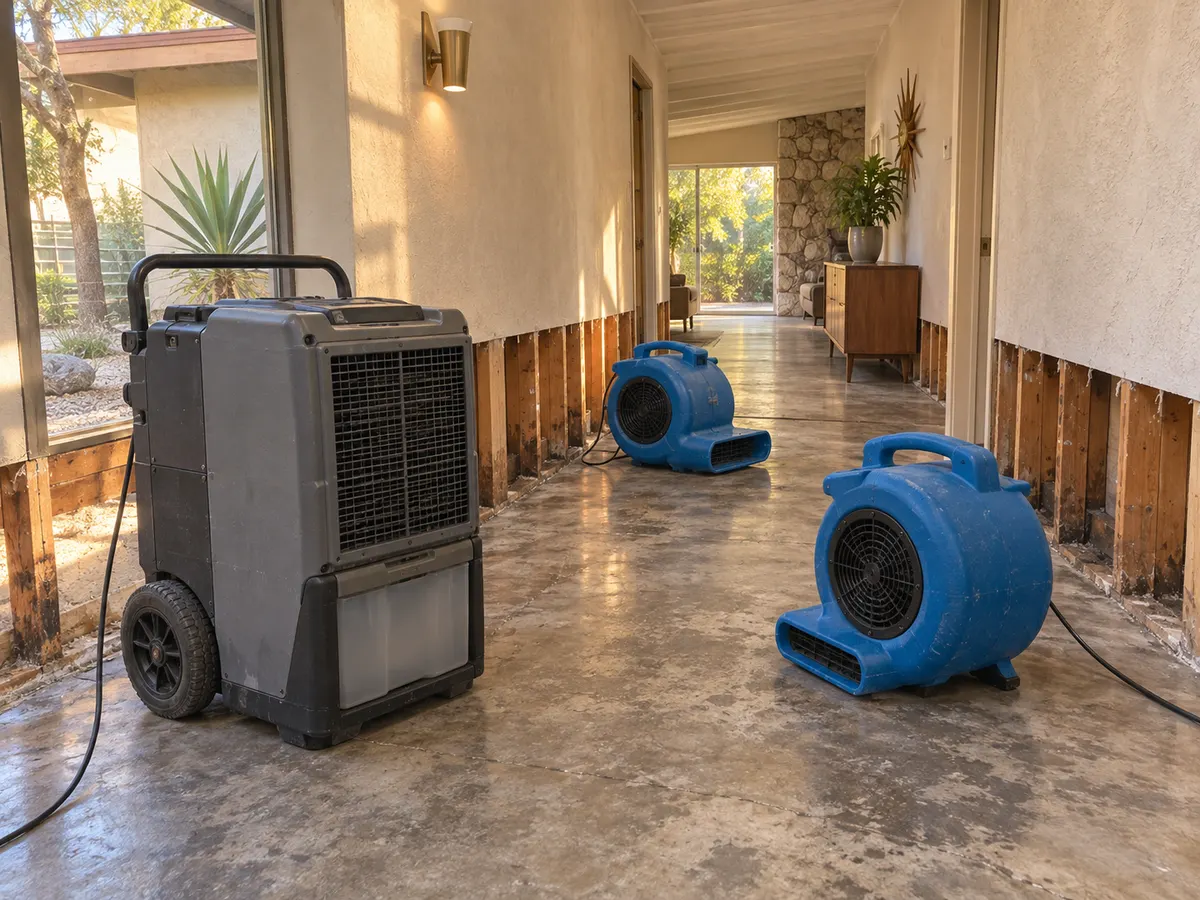
Typical steps
- Document. Photos and video of every wet area.
- Remove. Soaked pad, baseboards and debris bagged and hauled out.
- Clean. Surfaces the water touched are cleaned.
- Dry. Air movers and dehumidifiers run until dry.
Do
- Wear gloves when handling wet materials[CDC].
- Set aside items you want to keep so the crew knows.
Avoid
- Throwing things out before you photograph them[FEMA].
- Stacking wet boxes against walls.
Water damage room by room
- Kitchens. Dishwasher, sink and ice maker leaks run under the cabinets. Toe kicks often come off so air can reach the floor underneath, and cabinet backs are checked with a meter.
- Bathrooms. Toilet overflows, tub drains and shower valves wet the subfloor and the wall behind the fixture. A toilet overflow from the bowl is treated by its source, and a backup through the drain is Category 3[IICRC 2026 position statement].
- Laundry rooms. Burst washer hoses release a lot of water fast, and it usually reaches the next room under the wall. Drain backups bring gray water.
- Garages and water heater closets. A leaking tank spreads across the garage slab and under the wall into the house. Stored boxes on the floor soak up water and should be moved first.
- Bedrooms and living areas. Carpet and pad hold a lot of water. Extraction comes first, then the pad is checked; soaked pad is usually replaced rather than dried.
- Ceilings. Roof leaks and AC overflows wet insulation and drywall above. Wet ceilings can sag, so the area under them is kept clear.
What to do first when water gets into a home in the San Fernando Valley
- Stop the water. Close the fixture valve under the sink or toilet, or the main shut-off if you cannot find the source. It helps to find the main shut-off before you ever need it.
- Make it safe. Keep away from outlets, cords and fixtures that water has reached, and turn off power at the breaker only if you can do it from a dry spot[CDC].
- Document it. Take photos and video of each room, the source and damaged belongings before anything is moved[FEMA].
- Move what you can. Lift furniture onto blocks or foil, pull rugs off wet carpet, and get photos, papers and electronics to a dry room.
- Call for restoration. Drying should start within 24 to 48 hours[EPA], and extraction works better before water soaks deeper into the pad and walls.
Leave large amounts of water to extraction equipment, and keep lights and ceiling fans off under any wet ceiling.
The water damage restoration process in the San Fernando Valley
Most restoration work in the San Fernando Valley runs through the same six stages, whether the water came from a split supply line or a winter storm.
- Inspection and moisture mapping. The technician confirms the leak is stopped, then maps how far the water traveled with moisture meters and infrared cameras.
- Water removal. Submersible pumps take out deep water, and extraction units pull water from carpet, pad and hard floors. Mechanical extraction removes water much faster than air drying can.
- Removal of what cannot dry. Soaked pad, baseboards, the lower part of wet drywall and wet insulation come out when they cannot be dried in place. The EPA says wet materials that cannot be thoroughly cleaned and dried within 24 to 48 hours should be discarded[EPA flood cleanup guide].
- Structural drying. Dehumidifiers and air movers run in a closed space, and the goal is relative humidity under 60 percent, ideally 30 to 50 percent[EPA].
- Cleaning. Anything the water touched is cleaned. Items that cannot be disinfected, including wall coverings, cloth, rugs and drywall, should be thrown away, according to the CDC[CDC].
- Final readings. Drying is finished when the readings say so, not when the surface feels dry. Ask for the daily log.
Leaks you cannot see in the San Fernando Valley homes
Water moves outward under walls and cabinets instead of draining down. A leak in a hall bath can show up as a damp closet two rooms away.
Air conditioning is a frequent source. The EPA advises keeping AC drip pans clean and drain lines flowing[EPA], and notes that pans which do not drain can let water into the system[EPA]. When the air handler sits in the attic, an overflowing pan usually shows up first as a ceiling stain.
Places to check:
- Inside walls around leaking or sweating pipes[EPA]
- Under vinyl plank, laminate and carpet pad
- Behind the refrigerator ice maker line and dishwasher
- Under the water heater and washing machine
- Roof materials above ceilings after a roof leak[EPA]
Watch for a damp smell, baseboards that swell, stains that grow, floors that cup or buckle, and a water bill higher than normal. LADWP also suggests a dye test in the toilet tank to catch silent leaks[LADWP].
How long drying takes in the San Fernando Valley
The EPA’s target is to dry wet materials within 24 to 48 hours[EPA]. A small clean-water leak caught early can often be dried in a few days. After a flood, the EPA warns that drying out can take several weeks[EPA flood cleanup guide].
Outdoor air can help or hurt. EPA guidance is to bring in outside air when it is cold and dry and to dehumidify when it is warm and humid[EPA]. The technician checks conditions inside and out before deciding whether windows stay shut.
Leave the equipment running, keep doors to the drying area closed, and let the technician move it. Turning off air movers at night to cut noise can add days to the job.
Atmospheric river storms and water inside the house
Most Valley rain falls in a handful of winter storms. In February 2024, the National Weather Service recorded 4.10 inches at downtown Los Angeles on February 4 and another 2.93 inches on February 5, with 12.66 inches for the month, more than 9 inches above normal[NWS Los Angeles].
In heavy rain, the common entry points are roofs, skylights, window and door frames and garage thresholds. Ceiling water is the one to move on fast, because wet insulation and drywall above you add weight.
Keep people out from under a bulging ceiling and away from wet light fixtures, and photograph the damage before the crew starts[FEMA].
Talking to the restoration company
- What category is the water, and how does that change the plan?
- Where did the moisture meter show water, and how far did it spread?
- What needs to be removed, and why can it not be dried?
- How many dehumidifiers and air movers will run, and how often will someone check readings?
- Will I get a written scope and daily drying logs?
- Can you show your California contractor license?
Clear answers to these questions are a good sign. So is a technician who takes readings before quoting.
Before you go back into a flooded home
Turn around at flooded roads. Six inches of fast-moving water can knock an adult down, and 12 inches of rushing water can sweep away most cars, according to the NWS[NWS].
With water in the house, turn off power at the breaker if you can do it safely, and disconnect appliances before power is restored[CDC]. Document the damage with photos before anything is moved[FEMA].
Water damage cleanup by community
- Van NuysWater damage cleanup in Van Nuys, CA 91406 and 91405
- Sherman OaksWater damage cleanup in Sherman Oaks, CA 91403
- Woodland HillsWater damage cleanup in Woodland Hills, CA 91364 and 91367
- Canoga ParkWater damage cleanup in Canoga Park, CA 91303
- Sun ValleyWater damage cleanup in Sun Valley, CA 91352